


through sustainable liquid fuels
Lets TalkTerms and ConditionsMay 5, 2026
Stop Burning Waste. Start Extracting Carbon.
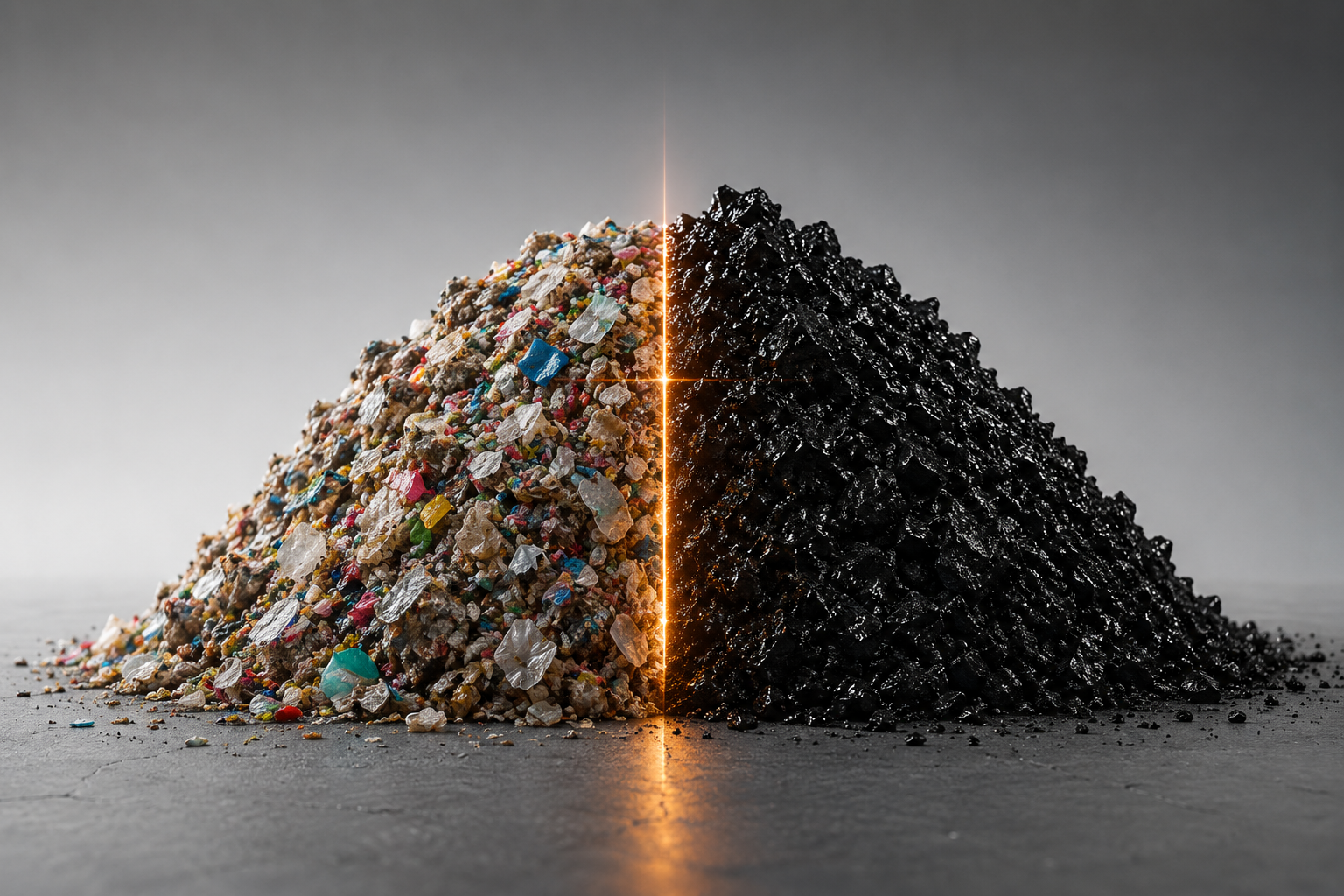
We’re Solving the Wrong Problem
According to the International Energy Agency Bioenergy, waste-to-energy and pyrolysis systems are primarily designed to maximise energy recovery, with solid carbon residues typically treated as low-value by-products rather than engineered materials. LINK
Solid Recovered Fuel (SRF) is still treated as something to destroy. It’s burned in cement kilns, power plants, and waste-to-energy systems. Even advanced pyrolysis is designed to maximise oil and gas while minimising the solid residue.
That approach misses where the real value sits.
The Carbon Everyone Ignores
Industrial trials consistently show that 10–30% of SRF converts into a solid carbon fraction (char) during pyrolysis.
Today, that carbon is:
- Discarded
- Burned as low-grade fuel
- Treated as contamination
Because it contains chlorine, alkali metals, sulphur, and trace heavy metals.
The result is a structural inefficiency. Carbon is concentrated… and then its value is lost.
The System Stops Too Early
Pyrolysis already does the hardest part:
- Breaking down complex waste streams
- Removing volatiles
- Concentrating carbon into a solid phase
But it stops there. It does not:
- Preserve carbon as a product
- Remove embedded contaminants
- Upgrade it into a specification-controlled material
So the system is optimised for energy recovery, not material production.
That distinction matters. Energy is consumed once. Carbon is a reusable industrial input.
From Waste-to-Energy → Waste-to-Carbon
Reframing SRF processing unlocks a different model:
- Carbon becomes the primary product
- Thermal systems are tuned for retention, not destruction
- Downstream processes focus on purification and upgrading
This is the foundation of a new industrial category: Carbon refineries built on waste streams
The Missing Capability: Purification
The constraint has never been carbon availability. It has been the inability to clean and control it.
SRF-derived carbon exists in a complex matrix:
- Contaminants are embedded, not surface-level
- Conventional treatments cannot penetrate deeply enough
- Materials fail industrial specifications
Unlocking value requires:
- Penetrating the carbon structure
- Removing bound contaminants
- Restoring a usable, controlled material
How ByoMax Solves It
ByoMax integrates three core stages into a single system:
1. Carbon Concentration
High-temperature pyrolysis using Multi-Hearth Furnace systems maximises carbon retention while removing volatiles.
2. Carbon Purification
Diffusion-based processes penetrate and clean the carbon matrix, removing embedded contaminants
3. Carbon Upgrading
Purified carbon is engineered into application-specific products:
- Industrial fuels
- Activated carbon
- Carbon black substitutes
What This Changes
This is not just a better waste solution. It redefines SRF:
- From disposal problem → strategic feedstock
- From energy recovery → material production
- From low-value output → specification-grade carbon
And critically:
It enables drop-in replacement of fossil carbon in high-temperature industrial processes—without changing existing infrastructure.
The Shift
For decades, systems have been designed to destroy waste as efficiently as possible.
But within that waste is carbon that is already:
- Concentrated
- Processed
- Industrially relevant
The shift is simple. But profound.
From burning carbon → to engineering it!